
Riders on the storm: Ethiopia bids to become wind capital of Africa
By Kieron Monks, CNN
Updated 1900 GMT (0300 HKT) January 3, 2017
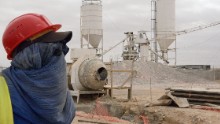
Photos: Air power
Rival powers – Several other African states are investing heavily in wind power and rival Ethiopia's prowess in the field. Morocco is a major player, and the Tarfaya wind farm is the largest capacity in Africa at around 300 MW.
Hide Caption
5 of 8
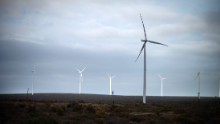
Photos: Air power
Rapid growth – South Africa also boasts abundant wind resources such as the 100 MW Sere wind farm in the Western Cape province, and the sector is expanding rapidly.
Hide Caption
6 of 8
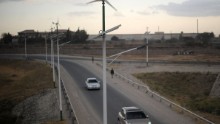
Photos: Air power
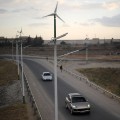
New dawn – Street lamps powered by wind and solar energy line the side of a road close to the Kenyan capital Nairobi. Kenya is making a priority of wind, notably through the Lake Turkana Wind Power Project that will be the largest in Africa with a capacity of 310 MW.
Hide Caption
7 of 8
Photos: Air power
Rapid growth – South Africa also boasts abundant wind resources such as the 100 MW Sere wind farm in the Western Cape province, and the sector is expanding rapidly.
Hide Caption
8 of 8
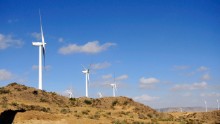
Photos: Air power
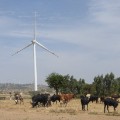
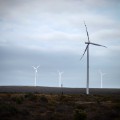
New powerhouse – The turbine of Ashegoda wind farm in Northern Ethiopia, which was the largest wind farm in sub-Saharan Africa when it was inaugurated in 2013. The $300 million facility represents a major step forward in Ethiopia's plans to become a renewable energy powerhouse.
Hide Caption
1 of 8
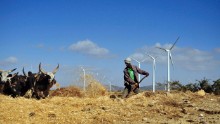
Photos: Air power
Power to the people – Just a quarter of Ethiopia's population had access to electricity in 2013, but the government aims to reach 90% coverage by 2020. Wind power is key to this ambition. According to the East African state's Growth and Transformation Plan II, wind output will rise from 324 MW to 5,200 MW in the next four years.
Hide Caption
2 of 8
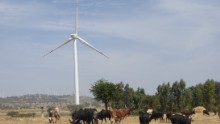
Photos: Air power
Transforming the landscape – Ethiopia's largest wind farm is now the Adama II facility, with a capacity of 153 MW, but the government plans to inaugurate at least eight farms by 2020.
Hide Caption
3 of 8
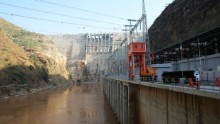
Photos: Air power
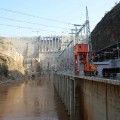
New elements – Ethiopia is also committing resources to developing other forms of renewable energy. The majority of its energy comes from hydropower, such as the recently inaugurated Gibe III dam in the Omo Valley, with a capacity of over 1.8 gigawatts (GW).
This will soon be added to by the Grand Renaissance Dam, which will be the largest dam in Africa, with capacity of 6 GW.
This will soon be added to by the Grand Renaissance Dam, which will be the largest dam in Africa, with capacity of 6 GW.
Hide Caption
4 of 8
Photos: Air power
Rival powers – Several other African states are investing heavily in wind power and rival Ethiopia's prowess in the field. Morocco is a major player, and the Tarfaya wind farm is the largest capacity in Africa at around 300 MW.
Hide Caption
5 of 8
Photos: Air power
Rapid growth – South Africa also boasts abundant wind resources such as the 100 MW Sere wind farm in the Western Cape province, and the sector is expanding rapidly.
Hide Caption
6 of 8
Photos: Air power
New dawn – Street lamps powered by wind and solar energy line the side of a road close to the Kenyan capital Nairobi. Kenya is making a priority of wind, notably through the Lake Turkana Wind Power Project that will be the largest in Africa with a capacity of 310 MW.
Hide Caption
7 of 8
Photos: Air power
Rapid growth – South Africa also boasts abundant wind resources such as the 100 MW Sere wind farm in the Western Cape province, and the sector is expanding rapidly.
Hide Caption
8 of 8
Photos: Air power
New powerhouse – The turbine of Ashegoda wind farm in Northern Ethiopia, which was the largest wind farm in sub-Saharan Africa when it was inaugurated in 2013. The $300 million facility represents a major step forward in Ethiopia's plans to become a renewable energy powerhouse.
Hide Caption
1 of 8
Photos: Air power
Power to the people – Just a quarter of Ethiopia's population had access to electricity in 2013, but the government aims to reach 90% coverage by 2020. Wind power is key to this ambition. According to the East African state's Growth and Transformation Plan II, wind output will rise from 324 MW to 5,200 MW in the next four years.
Hide Caption
2 of 8
Photos: Air power
Transforming the landscape – Ethiopia's largest wind farm is now the Adama II facility, with a capacity of 153 MW, but the government plans to inaugurate at least eight farms by 2020.
Hide Caption
3 of 8
Photos: Air power
New elements – Ethiopia is also committing resources to developing other forms of renewable energy. The majority of its energy comes from hydropower, such as the recently inaugurated Gibe III dam in the Omo Valley, with a capacity of over 1.8 gigawatts (GW).
This will soon be added to by the Grand Renaissance Dam, which will be the largest dam in Africa, with capacity of 6 GW.
This will soon be added to by the Grand Renaissance Dam, which will be the largest dam in Africa, with capacity of 6 GW.
Hide Caption
4 of 8
Story highlights
- Ethiopia signals massive expansion of renewable energy
- Investments will see sector grow more than 1000% by 2020
(CNN)Ethiopia is mid-way through a six-month state of emergency, but its renewable energy sector continues to make rapid progress.
The East African state has enjoyed a decade of strong growth, giving rise to profitable industries, new infrastructure, and showpiece summits.
To sustain this momentum, Ethiopia's government is pressing ahead with ambitious development plans, and clean energy is core to the mission.
Ethiopia was among the most daring signatories to the Paris Agreement on climate change, committing to cut carbon emissions by 64% by 2030. The government has ploughed billions of dollars into hydropower megaprojects such as the Grand Renaissance Dam -- which will be the largest dam in Africa -- and the freshly-inaugurated Gibe III Dam.
The next target is to become the wind power capital of Africa.

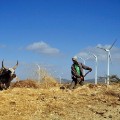
Camels walk along the road near turbines at Ashegoda wind farm in Ethiopia's northern Tigray region.
Breezing ahead
Ethiopia inaugurated one of the continent's largest wind farms in 2013 -- the $290 million, 120-megawatt (MW) Ashedoga plant. This was followed by the even larger 153 MW Adama II facility in 2015.
But wind accounted for just 324 MW of Ethiopia's total output of 4,180 MW at the end of 2015, with the vast majority coming from hydropower.
This picture is set to change with the government's second "Growth and Transformation Plan," which will see total output pass 17,000 MW by 2020, and a vastly increased share from the air.
The government has plans for at least five further wind farms, and potentially many more, aiming to deliver up to 5,200 megawatts from wind power within four years. The cost is officially calculated at $3.1 billion, although other estimates place it over $6 billion.
"We are conducting research and studying the data to see the number of plants we can connect (to the National Grid)," says Misikir Negash, head of communications for the Ethiopian Electric Power company. "It is important to have different energy sources for a reliable system. Wind is a big focus and we need it."
A 1,000% increase
The target of increasing wind output by more than 1,000 percent within four years has been greeted with skepticism in some quarters, but there are reasons to believe.
"The government has already taken on far bigger projects," says Zekarias Amsalu, director of Ethiopia Operations at market research group Asoko Insight, referencing the $6 billion Grand Renaissance Dam project. "I don't doubt it can be achieved."

Amsalu says that three factors are driving Ethiopia's shift to wind; the devastating droughts that have diminished the value of hydropower energy, the falling cost of wind power technology, and growing evidence that Ethiopia is blessed with ideal sites for harvesting wind.
The government has enlisted the Danish Energy Agency (DEA) as a partner, the Danish government agency that serves as one-stop shop for large-scale wind projects across the world, and special advisor Henrik Breum agrees that Ethiopia has vast potential.
"Their capacity should enable them to be a dominant wind nation in the region," he says. "They have very good winds in the dry season which is normally when you would like to top up electricity production...From a wind perspective this is one of the most promising countries in the continent."

Ethiopia is developing wind alongside a hydropower sector that delivers most of the country's renewable energy. The sector will soon expand through the Grand Renaissance Dam -- the largest dam in Africa.
Home and away
Despite Ethiopia's grand plans, development has been slow to arrive for many of the country's poor.
Just 26.6 percent of the population have access to electricity, according to the latest World Bank figures.
Negash disputes this figure, and insists there is no contradiction between pressing ahead with new technology and supporting wider access.

"We have different departments working towards parallel goals," he says. "We have a program to provide 90 percent of people with (electricity) access within five years."
Wind power is also expected to deliver wider benefits for struggling communities through training and job opportunities around the new sites.
Further, the plants are likely to strengthen Ethiopia's position in the region through trade. The country is already an exporter of energy to neighbors such as Sudan and Kenya, and wind power will offer new options.
"They can use wind to feed their local grid and export from their hydropower resources," says Amsalu. "Most of these are on the border so they are (ideal) for exports and gaining foreign currency."
Ethiopia's partners are hoping that the successful adoption of wind will drive a wider trend in the region.
"I think Ethiopia can be a very good showcase for renewables," says Breum. "Hopefully this can show neighboring countries that low carbon development of the power sector is possible."

![The Egyptian Assistant Foreign Minister, Ambassador Ibrahim Yusri [file photo]](https://i2.wp.com/www.middleeastmonitor.com/wp-content/uploads/images/article_images/people/ibrahim-yusri-yousry.jpg?resize=1200%2C620&quality=75&strip=all&ssl=1)
 December 30, 2016 - An Egyptian Foreign Ministry official called on Addis Ababa to stop what Cairo believes to be the provocation of crises between the two countries against the backdrop of Ethiopian accusations in October that Cairo supports the anti-government Oromo ethnic group, according to the Middle East Monitor.


