Mega Damming of the Life giving waters of Ethiopia. This process is menacing the existence of the inhabitants of the region by drying the sources and lakes. The main reason advertised for damming is for production of Electricity and exporting energy. This could be done by small human level dams.The underlying reason is to the irrigation for the great land grabbing for cash crop exportation for financial speculators. Moreover, such mega projects leads to undue water crisis.
Cairo - Egypt's president on Thursday expressed his "extreme concern" to Ethiopia's visiting prime minister over the lack of progress in talks on the impact of a massive upstream dam that Egypt fears could cut into its vital share of the Nile.
President Abdel-Fattah al-Sisi has warned that Egypt's share of the Nile, which provides nearly all its freshwater, is a red line. But he has also sought to reassure Ethiopia and Sudan that Egypt has no intention of going to war.
Sisi was grim-faced during most of a news conference he jointly addressed with Prime Minister Hailemariam Desalegn after the two held talks in Cairo.
El-Sissi said he appreciated Ethiopia's repeated assurances that the dam, which is about 60 percent complete, would not have a negative impact on Egypt, but he said studies must still be completed and that all sides should abide by their findings.
He said Ethiopia has rejected Egypt's proposal to bring in World Bank experts as neutral arbitrators on the dispute over the likely impact of the dam on Egypt's share of the Nile.
ADDIS ABABA, Ethiopia – Ethiopia's leader has rejected arbitration by the World Bank on a disagreement with Egypt over the hydroelectric dam that Ethiopia is building on the Nile River.
Prime Minister Hailemariam Desalegn on Saturday refused the suggestion made by Egypt in late December that the World Bank should be brought in to resolve the dispute with Ethiopia over the construction of the dam on the Nile River that Egypt says threatens its water security. Sudan is also part of the negotiations because the Nile flows through it on the way to Egypt.
"Ethiopia will not accept Egypt's request to include the World Bank in the tripartite technical committee's talks on the dam," Desalegn told the state run Ethiopian News Agency after visiting Egypt on Friday where he met with Egyptian President Abdel-Fattah el-Sissi. "There is an opportunity for the three countries to resolve possible disputes by themselves."
Egypt's suggestion came amid a 10-month impasse over technical negotiations for the dam, which will be Africa's biggest hydro-electric plant. Egyptian officials have called the World Bank "neutral and decisive" and said the organization could facilitate negotiations "devoid of political interpretation and manipulation."
But the Ethiopian leader said that "seeking professional support is one thing; transferring it to an institution is another thing. So we told them (Egypt) that this is not acceptable with our side." Desalegn said that Egyptians are not getting accurate information about the source of Nile waters and how Ethiopia's Grand Renaissance Dam will operate.
The $5 billion dam is about 63 percent complete. When finished it will generate about 6,400 megawatts, more than doubling Ethiopia's current production of 4,000 megawatts. The dam will also help to spare Ethiopia from drought and famine.
Ethiopia maintains that the dam's construction will not reduce Egypt's share of the river's water. It insists the dam is needed for development, pointing out that 60 million of its citizens don't have access to electricity.
But Egypt fears that if the reservoir behind the dam is filled quickly and if too much of the Nile waters are retained each year, the reduction of the river's flow would have negative effects on Egypt's agriculture.
Desalegn tried to reassure Egyptian during his visit to the country. "The people of Ethiopia did not nor will ever subject Egyptians to danger," said Desalegn, in Cairo Saturday on his first visit to Egypt as prime minister. "We will not hurt your country in any way and will work closely together to secure the life of the people of the Nile basin and take them out of the cycle of poverty."
While Ethiopia has said the dam is a "matter of life or death" for its people, Egypt has said water is a "matter of life or death" for its people.
KHARTOUM - Tension between Egypt and Sudan has increased this week amid military build-ups on their borders and fears that the crisis in the Gulf has now spread to eastern Africa.
Turkish media reported on 4 January that Egyptian forces have arrived in Eritrea, which borders eastern Sudan, with backing from the UAE and opposition groups from the region.
That same day, Sudan recalled its ambassador from Cairo, then two days later declared a state of emergency in Kassala state, which neighbours Eritrea, and shut the border without explanation. Eyewitnesses in Kassala have since said that large numbers of troops have passed through, heading towards the border area.
During the past year Sudan and Egypt, which have a long-standing emnity, have increasingly allied themselves with opposing Middle Eastern power blocs
Ahmed Abu Zeid, Egyptian foreign ministry spokesman, said Cairo was "comprehensively assessing the situation with a view to making the appropriate response".
The increase in tension comes just weeks after Turkish President Recep Tayyip Erdogan arrived in Khartoum, the first visit by a Turkish leader since the Ottoman Empire withdrew from Sudan in 1885. Sudan and Turkey signed 13 agreements during the December visit, including military accords.
Cairo didn't officially comment on Erdogan’s visit, but pro-government media have accused it as being a conspiracy against Egyptian national security. Khartoum in turn has denied the Egyptian accusations and says that Cairo has no right to interfere in Sudanese issues.
During the past year Sudan and Egypt, which have a long-standing emnity, have increasingly allied themselves with opposing Middle Eastern power blocs. Egypt has the backing of Saudi Arabia and UAE, the key advocates of a months-long blockade against Qatar. Sudan meanwhile has allied itself with Qatar and Turkey, which has a military base in the Gulf kingdom.
This is not the first time the two countries have fallen out.
Reason 1: Disputed borders
Aside from Eritrea, two other territorial disputes have strained Sudanese-Egyptian relations during the past half century.
The province of Darfur, in western Sudan, has been riddled by war for the past two decades, with up to 300,000 dead and at least 2.7 million displaced.
In May last year, President Omar al-Bashir said: "The Sudanese army has captured several Egyptian armoured vehicles in recent fighting in Darfur.” He has also previously accusedEgyptian intelligence services of supporting opposition figures fighting his troops in the conflict zones of Blue Nile and South Kordofan.
Member of the Sudan Liberation Army (Abdul Wahid faction) in North Darfur in May 2012 (UNAMID)
However, Egyptian President Abdel Fattah al-Sisi dismissed the accusations and said Cairo was not playing a role in Darfur. Rebel leaders have also rejected Bashir's comments.
Then there is the Halaib Triangle to the north of Sudan, run in effect by Egypt for the past two decades and which Cairo says is Egyptian territory. The region, rich in minerals and oil, has been disputed by Egypt and Sudan since the latter became independent in 1956.
Cairo has increased its military presence in the area since 1996, despite Khartoum's repeated complaints to the UN Security Council and calls for the dispute to be solved through arbitration.
In January 2016, Sudan put its forces on standby on the border with Egypt, the first time it has done so in 60 years, saying that Egypt's military was "provoking" the Sudanese army in the disputed area.
Reason 2: Deals with Turkey
Khartoum has been diplomatically and economically impoverished during the past decade. The country is still subject to international sanctions as a result of the conflict in Darfur, while Bashir is still wanted by the International Criminal Court for crimes of genocide. South Sudan took three-quarters of the country's oil revenue when it became independent in 2011.
Small wonder then that Sudan has sought international alliances where it can. During his visit, Erdogan said that the two countries aimed to boost two-way trade from $500mn a year to $1bn in an initial stage and then to $10bn.
Turkish President Recep Tayyip Erdogan (L) is embraced by President of Sudan Omar al-Bashir during an official welcoming ceremony at Khartoum international airport on 24 December (AFP)
Turkey, meanwhile, wants to boost its influence in the region, not least near international trade routes that pass through the Suez Canal to the north and the Gulf to the east.
Ankara has been active militarily in Somalia since 2009, when it joined the multinational counter-piracy task force off the Somali coast.
In September 2017, Turkey opened its largest overseas military base in the Somali capital, Mogadishu. It reportedly cost $50mn and will train 10,000 Somali troops, according to Turkish and Somali officials.
Ahmet Kavas, a former Turkish ambassador to the republic of Chad and an adviser to the prime minister on African affairs, told Middle East Eye that Turkey's presence in Africa made more sense than that of any other country.
"If you were to think of any one country that should be present in Africa, that country would be Turkey," said Kavas. "The anomaly was the 20th century, when we were largely absent from the continent and the western Europeans stepped in."
Two of the deals signed during Erdogan's visit drew particular drew sharp attention from Cairo.
The first leases Sudan's Red Sea island of Suakin to Turkey for 99 years. Over the centuries the island has been a commercial crossroads between Africa, Europe and the Gulf, as well as a gateway heading to the Arabian peninsula for Hajj. Historically, it is home to several ancient sites, dating back to when the Ottoman Empire colonised Sudan in the 18th century.
Turkey has said that parts of the island will be restored by the Turkish Cooperation and Coordination Agency and the ministry of culture and tourism.
But Asma Al-Hussieni, editor in chief of the Egyptian daily state newspaper Al-Ahram Egyptian, said in early January that Khartoum and Turkey have secretly agreed to establish a military base on the island, threatening the shipping lanes of the Red Sea.
The second deal allows Turkey to have an enhanced presence in Sudan's territorial waters across police, security, military and defence ministries, ostensibly to protect Sudanese naval ships as well as to fight terrorism.
Sudanese security expert and retired general Alabas Alamin said that Turkey's increased presence in the Red Sea is a "breakthrough for Turkish ambitions, which worries the Arab countries aligned with Saudi Arabia, especially Egypt".
There have been complaints about the deals from within Sudan. Abdallah Musa is a leading member of the Beja congress party, which represented a former rebel movement in eastern Sudan that signed a peace deal with the government in 2006.
Reports suggest Khartoum and Turkey have secretly agreed to establish a military base on the island of Suakin (Bertramz wiki commons)
He said the move is "a violation of the Sudanese sovereignty that will put Sudan in a critical situation amid regional conflicts" and that Egypt and Gulf states could be blackmailed if the waters were closed, disrupting oil routes to international markets.
However, the Turkish ambassador to Sudan, Irfan Neziroglu, denied Turkey would become involved in international affairs on Sudanese territories. "Turkey and Sudan have nothing to hide over the Red Sea or Suakin island," he told MEE. "What we announced openly is what will happen in the Red Sea."
Reason 3: Gulf alliances
The Gulf crisis which began in summer 2016 saw the Middle East divided between a power bloc opposed to Qatar which included Saudi, Bahrain, UAE and Egypt, and supporters of Doha, which include Turkey and Iran.
Emad Hussien, editor in chief of Sudan's Alshorooq newspaper, said: "Khartoum is clearly pragmatic and opportunistic as it jumps from one camp to another without any strategic goals other than to break the isolation of the regime."
Alhaj Warag, a political analyst and editor-in-chief of Turkey's Hurriyat online, said on Egyptian TV that Turkish ambitions have pushed Khartoum to build its current partnership with Ankara - but that this could put Sudan in a difficult position.
Sudan, Warag observed, had shifted from alliances with Iran to the Saudi-led coalition in Yemen to Turkey and Qatar. "Playing the regional axis to draw some benefits will end up having a serious effect on Sudan."
Musa warned that Sudan risked becoming the next Yemen. There, three years of war between sides backed by rivals Saudi Arabia and Iran have ripped the country asunder.
"To solve its economic crisis, Khartoum is putting the entire country in the middle of the regional polarisation," Musa said, "but that will lead to serious consequences."
Reason 4: Africa's biggest dam
Egypt is deeply worried about the impact on its water supply of the Grand Ethiopian Renaissance Dam, now being built near the border between Ethiopia and Sudan and set to be the largest on the continent.
Addis Ababa hopes the $5bn project will lift a large segment of its more than 80 million people out of poverty as well as allow it to sell on the energy produced and boost the economy.
Workers build the Grand Renaissance Dam near the Sudanese-Ethiopian border in March 2015 (AFP)
But in Egypt, where around 90 percent of the population live on or near the banks of the Nile, there are fears that there will be less water for irrigating crops. Cairo is also concerned that Sudan, through which the Nile flows, will side with Ethiopia in talks over the dam.
In December, Ethiopian media reported that Egypt wanted to exclude Sudan from the talks and invite the World Bank to arbitrate.
The Egyptian foreign ministry has denied the suggestion, stressing that Sudan is part of the talks that can't be excluded.
But a Sudanese diplomat, who asked not to be identified because he is not authorised to the talk to the media, told MEE the report was correct, adding: "The Egyptian stance regarding the dam is regrettable. Such moves from Egypt are unacceptable as they will only lead to more complications during the talks over the dam rather than solving the disputes."
Reason 5: The Muslim Brotherhood
Egyptian President Abdel Fattah el-Sisi came to power after he drove his predecessor, Mohamed Morsi, from office in July 2013. Morsi was a member of the Muslim Brotherhood, which is now banned in Egypt and whose members have been subject to unfair trials and torture, according to human rights groups.
Mohamed Morsi, former Egyptian president and member of the Muslim Brotherhood, is currently in prison (AFP)
In contrast, Sudan's Bashir rose to power in 1989 amid a military coup backed by the brotherhood and its leader, Hassan Alturabi, whom the current president later ousted when the organisation split in 1999.
Egyptian pro-government media have repeatedly accused Sudan of harbouring Egyptian members of the brotherhood, an accusation which has been denied by the Sudanese authorities.
Turkey has been supportive of the brotherhood: in February 2017, Erdogan said he did not consider it "an armed group, but is in actual fact an ideological organisation" and that if they had been associated with terrorism then they would have been driven from Turkey.
Hassan Ali, a political science professor at Alazhari University, believes the tension over the brotherhood is a sign of the ideological divide between Khartoum's Islamist government and the leadership in Egypt, which is increasingly having to deal with militant attacks in Sinai.
"These ideological differences are the main cause of tension between the two sides. The remaining issues including Halaib, the Ethiopian dam, and others are pending issues that been used as cards by the two sides to put pressure on each other."
So will there be war?
Yet despite the disagreements over dams and brotherhoods, islands and power blocs, experts believe it is in neither country's interest to engage in war.
Abdul Moniem Abu Idriss, a Sudanese political analyst, believes that the current tension is unlikely to descend from diplomatic and media spats into open military conflict.
Both countries, he said, are suffering deep economic crises, which will curtail their ability to fight or engage in escalation.
"Since 2011, these two neighbours have been suffering economic deterioration. Sudan has lost has the majority of its oil revenues since the separation of South Sudan in that year.
The two dictatorships in these two countries actually want to draw the attention of the people away from their domestic crises
- Alhaj Hamad, Sudanese Centre for Social and Human Development
"Meanwhile Egypt's tourism, which is a vital sector for the Egyptian economy, has been hit by the continuous terror attacks."
Egypt also goes to the polls in March – and a wave of nationalist fervour, sparked by relations with Sudan, might strengthen the hand of Sisi with his previous background as defence minister, commander-in-chief of the armed forces and director of military intelligence.
Idriss also believes that each side is "attempting to create an imaginary enemy to draw the attention of the two nations from their realistic and daily life needs that they failed to provide".
"Even the Egyptian military presence in Sudan, especially in Halaib, is old and dates back to 1996, so I don't think that there is something new in this regard," he added.
And despite Turkey's pledges to back Khartoum in any Egyptian attack on the Red Sea coast, both sides are too fatigued for war.
Alhaj Hamad, director of the Sudanese Centre for Social and Human Development, said: "The two dictatorships in these two countries actually want to draw the attention of the people away from their domestic crises."
He said that neither side could afford even the pretence of engaging in open war. "I don't think that they will go further. This current situation is best called the balance of weaknesses."
January 13, 2018 (KHARTOUM) - Sudan’s Ambassador to Egypt Abdel-Mahmoud Abdel-Halim said his country would take further escalatory actions against Egypt within days.
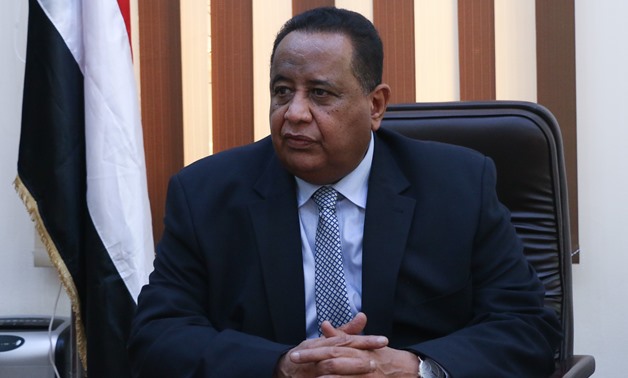
Ambassador Abdel-Mahmood Abdel Halim
On 4 January Sudan summoned its ambassador to Egypt for consultation, hours after the head of the Sudanese Border Technical Committee, Abdallah Al-Sadiq, accused Egypt of trying to drag Sudan into a direct military confrontation.
Speaking to journalists on Friday night, Abdel-Halim said his summoning was a step in a series of moves that could include “withdrawing of ambassador or expulsion of other country’s ambassador or breaking off the relationship and declaring war”.
He pointed out that Sudan has taken the first step in the diplomatic battle with Egypt and didn’t yet resort to other options.
However, Abdel-Halim did not explain the reasons for the Sudanese escalation towards Egypt, but only expressed hope the two countries could overcome the current challenges.
“In every challenge there lies opportunity and we want to take advantage of this opportunity to put our relationship with Egypt on the right path through resolving the outstanding issues which prompted my summoning,” he said
The Sudanese diplomat warned that his country could take further escalatory moves, saying important developments will occur in the next few days in this regard.
New tensions have erupted between Sudan and Egypt following Turkish President Recep Tayyip Erdogan’s visit to Khartoum in late December.
Last week, Sudan closed its border with Eritrea after the deployment of thousands of troops from the Rapid Support Forces (RSF) fighters to Kassala State.
On Thursday, Sudan admitted that the deployment of troops along the Eritrean border came as result of military threats from Eritrea and Egypt against the country.
CALL FOR MILITARY MOBILIZATION
Meanwhile, the governor of Khartoum State and head of the National Congress Party (NCP) in the capital has underscored readiness of the army, security, and the RSF to counter any kind of aggression against the country.
Hussein, who spoke before the meeting of the NCP’s Shura Council, called on the members of the ruling party to get ready “to wear the Khaki (army uniform) and go to the battlefield in defence of Sudan’s dignity and the dignity of its people”.
However, Hussein didn’t elaborate on the nature of the military aggression.
He said the summoning of Sudan’s ambassador to Egypt was meant to underline Sudan’s keenness to maintain the fraternal relations between the two countries on the bases of mutual respect.
Hussein also demanded to stop the hostile Egyptian media campaign against Sudan led by some who hold hidden agenda to hurt bilateral relations.
CAIRO - 14 January 2018: Sudan has denied media reports that its ambassador to Cairo Abdel Mahmoud Abdel Halim said Khartoum would “escalate” the situation against Egypt, a few days after being summoned to his country for consultation.
“The Sudanese Foreign Ministry has totally denied any remarks were given by its ambassador to Egypt…The ambassador was attending a social event and he talked about the (diplomatic) meaning of summoning an ambassador,” the Sudanese Foreign Ministry said in a statement on Saturday.
“Sudan is keen on achieving stability and peace in both countries,” the statement added, noting that the ambassador was quoted out of context.
Russia Today reported on Saturday that Abdel Halim told Sudanese reporters that Khartoum “has taken tougher steps against Cairo and new development will take place in the coming few days and will be more violent.”
“We are at the beginning of our diplomatic process, which starts with summoning the ambassador for consultation and then withdrawing the ambassador…and third, dismissing the ambassador of the concerned country. Fourth, boycotting the diplomatic ties and fifth, declaring the war,” stated an Egyptian government official.
On January 4, Abdel-Halim was withdrawn for consultation, according to the Egyptian Foreign Ministry, which replied that Cairo was evaluating the situation in order to act accordingly.
Two days ago, Ibrahim Mahmoud, the assistant to the Sudanese President, said that his country “faces (potential) military threats” from Egypt and Eritrea after claiming that there have been “military movements from Cairo and Asmara along the Sudanese eastern borders,” BBC reported. However, Eritrea has totally denied any Egyptian military movements, saying such remarks are “groundless.”
In a phone call to Sabahak Masry talk show on MBC channel on Monday, Egyptian ambassador to Eritrea Yasser Hashem stated that Egypt has no military bases in Eritrea or any other country.
Sudan claims that it has sovereignty over Halaib and Shalateen triangle, which is located inside Egyptian territories. Halaib and Shalateen, or the Halaib Triangle, is an area of land measuring 20,580 square kilometers, located on the Egyptian-Sudanese border on the Red Sea coast. It is part of the Red Sea governorate and consists of three major towns.
The area belongs to Egypt politically and administratively, but has been one of the major sticking points in Egyptian-Sudanese relations since the demarcation of borders between the two countries carried out during the British occupation of Egypt in 1899, at a time when Sudan was part of the Egyptian Kingdom.
Recently, the bilateral relation tensed concerning the controversial Ethiopian Renaissance Dam. Sudanese media claimed that Egypt has sought to exclude Sudan from the tripartite talks with Ethiopia. On January 8, Foreign Minister Shoukry stressed that Egypt did not ask Ethiopia to exclude Sudan from negotiations.
Egypt has voiced its concern over Ethiopia’s dam construction, as it would affect Egypt’s 55 billion cubic meter share of the Nile water. However, Addis Ababa sees the dam is necessary for its development and would not negatively affect the downstream countries (Egypt and Sudan).


 Member of the Sudan Liberation Army (Abdul Wahid faction) in North Darfur in May 2012 (UNAMID)
 Turkish President Recep Tayyip Erdogan (L) is embraced by President of Sudan Omar al-Bashir during an official welcoming ceremony at Khartoum international airport on 24 December (AFP)
 Reports suggest Khartoum and Turkey have secretly agreed to establish a military base on the island of Suakin (Bertramz wiki commons)
 Workers build the Grand Renaissance Dam near the Sudanese-Ethiopian border in March 2015 (AFP)
 Mohamed Morsi, former Egyptian president and member of the Muslim Brotherhood, is currently in prison (AFP)
 Email
Email Print
Print Save
Save